Tuesday, June 23, 2020

The Mountains Wild by Sarah Stewart Taylor

This book comes out today (June 23)—don’t miss it!

Maggie D’arcy, a Long Island homicide detective is called to Ireland to assist on a case of a missing woman.  It’s Maggie’s second visit to Ireland, the first being when she went 23 years before to look for her cousin, Erin Flaherty, who had moved there and had then disappeared.  Back then, and currently, the Irish police believed that the cases were related to other missing woman cases where there was a possible two-week window to find the person before she was murdered.

Maggie goes with many conflicting feelings: leaving her young daughter at home, re-opening old wounds, fear for her uncle’s health as Erin’s case is again highlighted, seeing an Irishman who has never left her heart, and being the outsider who is not officially part of the investigation.  When she meets up with Roly Byrne, the detective from the case years ago, she meets up with a friend with whom she is now on equal footing after a successful career in homicide.  She works with Roly and with his new partner, Detective Garda Katya Grzeskiewicz, Griz for short (and for ease).

Maggie spends time between places in Dublin and south in the Wicklow Mountains where Erin was thought to have disappeared and where the current woman went missing while out hiking.  Searching through old case files, following new leads, retracing steps in Dublin and around Glenmalure, throwing around new ideas, setting up timelines and psychological profiles, Maggie keeps getting a little bit closer to understanding both her cousin and suspects, but she and Roly and Griz all wonder if it will be in time to save the current victim.

This is a really substantial, atmospheric addition to procedural-type mysteries.  The streets of Dublin and the wild beauty of the Wicklow Mountains are wonderfully described here in a story that alternates between 1993 and young Maggie and 2016 and the older, wiser, more hardened detective.  The result is a carefully rendered portrayal of a case that builds with suspense, surprises, and suppositions.  There are a couple great "oh no" moments and a brilliant twist with believable characters and unsavory secrets. 

Thanks to Edelweiss and Macmillan for an advance copy.

Thursday, June 4, 2020

500 Miles from You by Jenny Colgan

Sometimes, we can be really distant from our understanding of ourselves, from the people we need and love, and from where we ought to be.  Jenny Colgan writes about this in fresh new ways in 500 Miles from You, the third book in her Scottish Bookshop series, but which can be read on its own. 

Lissa Westcott, a nurse practitioner liaison for the National Health Service, visits patients at home in the busy city of London.  She knows many of her patients well and treats them skillfully, often with humor, to encourage them to live more healthy lives.  On her way between patients one day, she witnesses the violent death of a teenage boy she knows when a car plows deliberately into a group of his friends.  Despite the help of her friends and employer, nothing seems to help her move past this trauma, until she is forced to take a leave and work for three months in a remote town in Scotland.

She trades places with an unknown colleague, Cormac MacPherson, also a nurse practitioner liaison in little Kirrinfief on the shores of Loch Ness.  Cormac, a former Army medic, is suggested for this exchange to broaden his nursing skills.  Neither is happy about the move, but they do an exact change—in jobs and in living arrangements—with Lissa moving into Cormac’s Highland cottage and Cormac taking Lissa’s small room in a group housing residence for hospital employees. 

Both discover that they are completely out of their elements, puzzled by the impersonal nature of the city (Cormac) and the closely monitored life of a small village (Lissa).  The loud, pollution-filled mayhem of London disturbs Cormac, and the quiet, idyllic lanes of Scotland do not sit well with Lissa at all.

They are forced to correspond—first through case notes, then with e-mails, moving into texts, as they share information on their patients and on the confounding people and places they encounter.  Slowly, they each develop an appreciation for the places they are in and learn and heal in heartwarming ways.

The Proclaimers song “(I’m Gonna Be) 500 Miles” is kind of the behind-the-scenes theme for this fun book, which is about a developing friendship and romance, but also a love letter to two disparate locations that are beautifully described.  Let Jenny Colgan’s new book take you away for an enjoyable armchair tour of Scotland and London and a surprising introduction to the life of a nurse. 

500 Miles from You is published on June 9.  Thanks to Harper Collins and Edelweiss for an advance copy.  Other books in this series are The Bookshop on the Corner and The Bookshop on the Shore.

Sunday, May 17, 2020

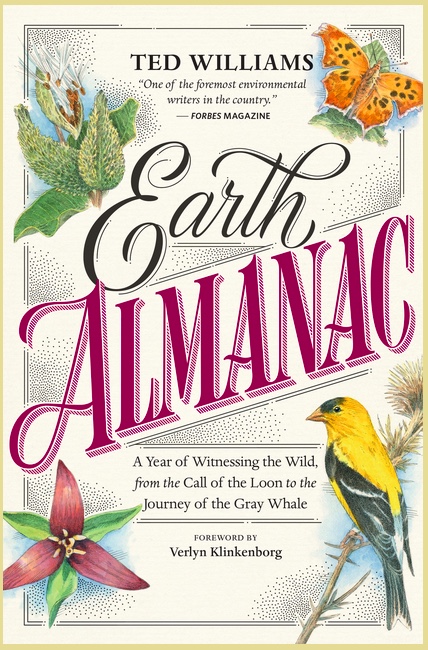
Earth Almanac by Ted Williams

We have all been put into a strange place during these days of pandemic isolation, and I feel like I have been blessed with having time to stop and smell the flowers.  In my reading, I have discovered a new book that will help everyone do the same.

Earth Almanac by Ted Williams was due to be published on April 28, but it is now being released on September 29.  I think that it is well worth the wait, but I have one solution to consider at the end of this review.

Earth Almanac is being published by a small independent press called Storey Publishing in Massachusetts.  They specialize in books on nature, gardening, and how-to subjects, including an excellent line of knitting books, like One Skein Wonders.  Postponing publication has been happening with many books during this pandemic, and when I reached out to this publisher about their decision, they said:  they decided to delay publishing several books “because, with so many sales channels and libraries closed, they don’t want to release books into a market that limits readers’ options for accessing them.”

The book is collection of mini essays arranged around the seasons, with a longer introductory essay for each season.  It’s not really a field guide, as such, but it could be used during walks to inspire you to look for the things that he so minutely observes or to make you recollect scenes from your past.

I highly recommend this book for readers of all ages for three reasons.

1. The first is that these are all very short essays, taking maybe 30 seconds to 2 minutes to read.  They are completely self-contained, do not need to be read in any order, and can be picked up at any point without losing any sense of meaning.  I can’t think of a better solution in this time of distraction.  It was difficult to choose one essay to share, but here is this one, called “Underdogs” (page 92):

    Remove the black-tailed prairie dog from its niche in our western plains and—as Americans have discovered over the past century—the whole biota collapses like the sides of stone arch.  This ground squirrel, whose “dog” name derives from its bark, is called a keystone species because it provides food and/or habitat for at least 59 vertebrate species—29 birds, 21 mammals, 5 reptiles, and 4 amphibians.
    The elaborate subterranean design of a prairie-dog town includes bedrooms, latrines, birthing and nursing chambers, pantries, even cemeteries.  In May look for youngsters as they stumble up into the sunlight for the first time in their six-week lives.  Soon they’ll be roughhousing, grooming each other, and greeting neighbors with chirps, hugs, and open-mouthed “kisses.”
    Because prairie dogs eat forbs and grasses, they have been widely poisoned and shot in the mistaken belief that they compete with livestock.  Studies, however, show that in aerating and turning over the soil they produce high-quality forage.

While this one focuses on the plains states, the majority deal with nature in our own Northeast region.

2.  The second reason to read this is that these are exquisite little pieces that Williams writes in a fun, descriptive way that is often poetic and literary.  When talking about the elusive river herring, for instance, he writes “Mostly they pass unseen, save by herons hunched over the pools like old men in ratty down jackets standing at a truckstop counter.”  (page 89)  He creates essay titles that reference classic poetry, “Ode to a Devil’s Urn” is one example, and he quotes from the children’s classic Charlotte’s Web by E.B. White to describe how many juvenile North American spiders disperse.

3.  The third reason is that Williams writes engaging pieces that combine natural observations and scientific research that draw readers in by making them exclaim over the startling facts—did you know that chipmunks can hold up to two heaping tablespoons of corn kernels in their cheeks?  He also gives how-to instructions on interacting with nature, such as finding and cooking wild leeks in the spring.   And, he talks about ways to involve kids (don’t go on a nature walk, say that you’re going on an expedition) and then suggests ways to get them fully involved.  Puff the Magic Fungus (page 194) is one essay that is a good example of this:
   
      Puffballs, those fungi that appear throughout most of North America after autumn rains, on rich humus and over buried stumps, seem made for kids.  The smoke that spews from the hole atop the dry, leathery husk when you tap it or step on it is spores from the already-dead fruit.  So fine are these spores that they can drift to elevations of five miles and travel between continents.  The giant puffball, which sometimes reaches four feet in diameter, may produce 7 trillion spores annually.
     But the magic doesn’t end there.  Depending on which of the 270 species you encounter, a puffball may grow from the size of a golf ball to the size of a baseball in a single night.  Moreover, the main part of the plant—the mycelium—lives underground and extends in all directions through the soil, sometimes creating a circle of puffballs above.  A much older—and, some would argue, better—explanation has it that these circular growth patterns are set by the feet of dancing fairies; hence the popular name “fairy rings.”  Since this theory cannot be disproved, why hasten its extinction when you are afield with young companions?
 These essays are magical and not to be missed.  It turns out that Earth Almanac is an updated version of Williams' earlier book called Wild Moments.  This is only available as an e-book and is on Hoopla, which is a library resource for ebooks, audiobooks, movies, and music. 

(This was used as a talk for the Richmond Memorial Library's "Lunch Time Book Chats" shared on Zoom on May 13.  Thanks to the publisher and Netgalley for an advance copy.)

Wednesday, May 6, 2020

The Tourist Attraction by Sarah Morgenthaler

Debut author Sarah Morgenthaler sets up a funny rom-com in the tiny Alaskan town of Moose Springs, where Graham Barnett, the owner of the Tourist Trap diner shows real disdain for his out-of-town clientele and where unconventional tourist Zoey Caldwell makes him set aside all his preconceived notions and rules about how to treat the "enemy." 

Zoey revels in being in Alaska, although it has come from personal budgetary sacrifice to get there.  She is enthusiastic about everything and wants to experience as much as possible, even when it means taking the cheaper and less impressive excursions or finding her own way through local forest trails.  And because of that, she is thrown together with Graham in some pretty spectacular ways, starting with interrupting his wood sculpting in full mask and chain saw.  What’s a girl to do?  Zoey’s instincts go into full survival mode, leaving Graham wondering whether he will ever be able to father children.

Included in the funny setups are the characters that the author introduces.  She has a great way of juxtaposing types of people with things that just don’t seem to match, like Graham’s having coordinating outfits and hats for his sheepdog Jake. 

One of the great things about the book is that anyone who has traveled or worked within the tourist industry knows that the portrayal of the guests at the high-end resort are pretty close to the truth, and the truth hurts.  People ARE often thoughtless and spoiled when traveling to other places, and they don’t come off in ways that play well for the locals.  It’s used very effectively here, and it provides a lot of humor as well as some suspense. 

Although readers will know where the ending is going (yes, it has to be a happily every after), the way that it is done is creative and fun and not as predictable as expected.  Interplay is flirty and sassy with lots of innuendoes, but the deed is behind closed doors.

Some of this does stretch credulity (a truck stop waitress is best friends with a wealthy entrepreneur? Ulysses the moose is in love with the fresh baked cinnamon rolls?), although the story of moneyed and inconsiderate tourists, the natural beauty and dangers of Alaska, the budget tours gone wrong, the hilarious conversations between Graham and his friends and Graham and Zoey all add up to diverting light reading. 

(Sourcebooks, 2020)  Thanks to Edelweiss and the publisher for an advance copy.

Saturday, May 2, 2020

Beach Read by Emily Henry

(The pandemic has turned the publishing world upside down, but Beach Read by Emily Henry appears to be coming out as planned on May 19  from Penguin Random House). 

January Andrews writes women's fiction; Augustus Everett writes literary fiction. The two had a love/hate relationship in college when January knew him as Gus and when his seemingly arrogant attitude and critical commentary of her work cooled other feelings for this guy she and her friend nicknamed Sexy, Evil Gus (or SEG for short).  He sees her as the fairy princess of all sweetness and light, she views him as the angsty, brooding writer who sees only the dark side. 

Now, several years later, they are published authors, hitting the bestsellers list at the same time, although Gus is, disturbingly, three slots ahead of January.  They are also both having major writers' blocks, and when January runs short of funds as well as ideas, she heads out to the vacation town in Michigan to the house her late father left her...right next door to Sexy, Evil Gus.

Well, what could go wrong--or right?  Their "reunion" meeting at the local bookstore is anything but cordial, and their attendance at the evening's book discussion takes their relationship to new lows.  But, it does prompt them to place a bet that may restart their writing.  January challenges Gus to write a rom-com and he dares her to write literary fiction.  Going along with the bet are educational evenings for research and ideas on character and plot development, how romance is started and how to understand the bad things that happen to people.

Their conversations are snarky and flirty, and the first half of the book does read like a rom-com, but it changes about halfway through as serious and darker themes are explored as they relate to the lives of each of them, both personally and professionally.

This is an entertaining, page-turning and unusual story that has fun references to popular authors and some great secondary characters including a true eccentric who runs the local bookstore.  There literally IS a beach read here, but not in the way that they are generally understood. 

Thanks to Edelweiss and the publisher for an advance copy.

Thursday, April 9, 2020

The Jane Austen Society by Natalie Jenner

(Releases May 26) This lovely novel by debut author Natalie Jenner imagines how a group of people who cherish the works of Jane Austen find each other and propose a special society to honor the beloved author in the small village of Chawton, Hampshire. 

Few groups could be as diverse in personality and circumstance as the one that gathers right after World War II.  There’s a bachelor farmer, a country doctor, a respected solicitor, a young widowed teacher, a high school dropout, an Austen descendent from the Knight family, a Sotheby’s representative, and an American movie star.  While some of the group have known each other since childhood, others meet serendipitously through their appreciation of Jane Austen’s works.

In the first chapter, so beautifully described, a young farmer stretches out on a churchyard wall to rest after early morning labors.  He is interrupted by a chic American woman who is looking for the home of Jane Austen.  Her admiration of this author, from this very village, encourages him to read her novels, where he finds a kindred spirit and hope in a seemingly hopeless world of death (his two brothers were killed in WWI, his father in the Spanish flu) and loneliness.

A young teacher at the school, forthright and confident, loves teaching her students the works of Austen until she is challenged by the all-male school board, is widowed within one year of marriage and loses her baby at birth.  A middle-aged woman sits in the ancestral home, surrounded by beloved objects related to the Austen family, but is totally intimidated by her domineering father who is on the edge of death.

Each character faces his or her own challenges, often of immense loss or lack of understanding, and each finds consolation in the Austen novels.  When they gather to think about how to pay tribute to their favorite author, they have to overcome some long odds, involving money, last-minute wills, and unscrupulous real estate deals—not to mention getting past their own shortcomings and personal challenges. 

This is a life-affirming novel that is quiet and hopeful and pays great tribute to an author and her works with many quotable sentences and paragraphs about the power of literature.  It is set apart from many Austen adaptations by its time period, plot, and cast and reminds me of one of my favorite novels about a group of readers, The Guernsey Literary and Potato Peel Pie Society.  Highly recommended, especially during these discomforting times. 

Thanks to Netgalley and St. Martin's Press for an advance copy.

Thursday, April 2, 2020

Hid from Our Eyes by Julia Spencer-Fleming

In 2005, local readers (in western New York) were introduced to Julia Spencer-Fleming, whose first novel In the Bleak Midwinter was the title for the one-book program called "A Tale for Three Counties."  That visit and book started a devotion to this author who has consistently provided interesting and topic-filled mysteries starring Episcopal priest Clare Fergusson and Police Chief Russ Van Alstyne.  Hid from Our Eyes (Minotaur Books), her ninth book in the series is out on Tuesday, April 7.  It’s another outstanding mystery that showcases the strengths of this writer and proves why she has such a loyal following. 

The book opens in 1952 with the discovery of a young woman’s body on the remote McEachron Rd. in the small Adirondack township of Cossayuharie.  Wearing a party dress and nicely groomed, she is missing her shoes, stockings, and purse with no signs for a cause of death.  In 1972, another corpse is discovered, same location, same conditions, same time of year.  Then fast forward to the present, when a third young woman’s body is found in the exact way, and Chief Van Alstyne is now in charge of the investigation. He has ties to the previous unsolved death—and not in a good way—as he was the scruffy young Vietnam vet, just home from the war, who discovered the body.

These unexplained deaths propel the mystery.  Circling through three time periods, the story also involves the current issues of the Millers Kill Police Department which is facing a town referendum on dissolving the force.  Committed to providing a safe community, Russ is also concerned for the members of his staff who need their jobs to survive.  Facing a particularly difficult situation is Officer Hadley Knox, a single mother who has returned to Millers Kill to provide a stable home life for her children and to look out for her grandfather, but whose dubious past is exposed to her fellow officers by her vengeful ex-husband.  As if that wasn’t enough, the department is hit with a lawsuit alleging that she and former MKPD Officer Kevin Flynn roughed up her ex-husband and planted drugs in his suitcase.

Despite the distractions, Russ focuses his department on searching for answers to the death of this unknown subject, knowing they face particular public scrutiny at this time while also acknowledging that they are grasping at straws.  Their legwork takes them several places, revisiting people of interest from 1972, looking into local resorts and restaurants, following up on cell phone use, and going to check out the itinerant carnival workers at the the annual Washington County Fair.  At the fair, the absent Officer Flynn surfaces, as he is working undercover investigating domestic extremism for his new job with the Syracuse PD. 

Meanwhile at home, Russ is settling into newly married life with Clare and their baby son Ethan.  Clare is having trouble adapting to motherhood, trying to do too much and not willing to accept enough help from caregivers and her mother-in-law.  Her stress provides some real challenges to her mental health and her ongoing struggle with substance abuse, but she soldiers on, reaching out to people in need, continuing her parish duties, and taking on a new seminary intern who provides entry into the community of monied seasonal residents and their interest in the Save Our Police campaign. 

There’s a lot going on here with themes of misogyny, tax cuts, PTSD, cold cases, community policing, and transgendered people, but it is skillfully handled and woven seamlessly into the story.  Some of it is fairly melancholy as the demons of past lives and the pressures of current ones weigh heavily on many characters.  Fortunately, it is leavened with the author’s trademark humor, which can be ironic and witty.  The bantering among the officers and between Russ and Clare, the misunderstandings across generational divides, and the characters’ hidden thoughts and asides are lots of fun. The inclusion of hilarious moments between Russ and a certain Snoopy tie-wearing reporter, based on the Daily News’ own editor Ben Beagle, is laugh-out-loud funny.

This may be the longest book in the series, but it is as creative and fresh as the first book with a maturity in writing.  Short chapters, moral dilemmas, familiar characters, and a complex mystery make this compelling reading.  I’ve read the book twice, and I can say that the resolution to the mystery is exceptionally clever and unusual but that the clues are provided with fairness.  It ends on a cliffhanger that involves not one, but two of the characters’ stories. 

It’s been six years since Julia’s last book was published, in part because she is a self-admittedly slow writer and in part because of the illness and death of her husband. Her oldest daughter, a columnist for a Maine newspaper, reports that Julia is weathering the current coronavirus crisis by sitting at her kitchen table and working on her next book, which is good news for all of us.


(Thanks to the publisher and BookishFirst.com for an advance copy of the book.)
Veil of Doubt by Sharon Virts

A story of a serial killing? Not my thing!  But I chose to give a new piece of historical fiction a try, and I discovered a fascinating co...