Monday, October 7, 2019

The Giver of Stars by Jojo Moyes

The book opens with two journeys: the first is Margery O’Hare’s treacherous climb in the dead of winter up Arnott’s Ridge on her trusty mule Charley to deliver books to distant cabins, the second is newly married Alice Van Cleve's, who has moved to the small coal town of Baileyville, KY from England.  Their paths eventually intersect in this compelling adventure about the WPA Packhorse Library in eastern Kentucky during the Depression.

Independent and courageous, Margery lives life by her own terms in this coal town and is alone except for the persevering love of Sven Gustavsson.  Raised in the most brutal of circumstances, she finds her calling in delivering books and magazines out to the many poor and isolated families in her area, checking in on widows and young families and encouraging the education that books can bring to resistant recipients in the backwoods.

The journey that the elegant Alice Van Cleve makes when she fell in love with handsome American Bennett Van Cleve takes her a long way from her English home.  His marriage proposal seemed like the perfect escape from the stifling atmosphere for this headstrong young woman, but Baileyville isn’t the imagined destination and neither is married life to the wealthy but distant man.

Alice tries to blend in to the small community, but housekeeper Annie has things well in hand, the interminable meetings attended by the local women bore Alice, and the intrusions into married life by her father-in-law frustrate and anger her. When Alice volunteers for the newly established packhorse library, Margery is more than a little skeptical but Alice is determined and Margery has few other choices.

Alice and Margery come from worlds apart, but their travels up and down the Appalachian hills bring a new respect for each other as they cobble together the library service with several other women in town: Mrs. Brady, who oversees the operation, quiet and polio-stricken Izzy, brash Beth who comes from a household of men, and the efficient Sophia who organizes everything hidden behind locked doors, because she is black.

Author Jojo Moyes builds her world with lovely descriptions of the seasons, harsh commentary on the lives of miners and the ecological devastation that mining brings, a heart-pounding scene of a substantial flood—all tied up with the developing sisterhood of this group of women and the education that their library brings.  It is inevitable that conflict arises when these librarians surreptitiously provide information to women about “married love” and also share important legal advice concerning the mine’s intended land grab. 

When Alice’s relationship with her husband and father-in-law takes a turn for the worse because of these issues, she leaves and stays with Margery, but her father-in-law (and mine owner) is out for revenge which puts her, Margery, and the library project into serious trouble.  The story is such a compelling one, and the journeys that the characters take are not only out into the hills but are ones of self-awareness and empowerment.

I was reluctant to read this at first, because the very fine novel “The Book Woman of Troublesome Creek” by Kentucky scholar Kim Michele Richardson covered this same topic earlier in the year.  The books are similar in this theme, but each are unique in tone and detail, and I highly recommend both (Richardson’s book is reviewed below on April 17, 2019).  The theme of cultural change through the efforts of a small group of women is beautifully rendered here, and the plot includes some really gut-wrenching and emotional scenes.  This is a place and time in American history that is good to be remembered.

(Viking, October 8, 2019)


Tuesday, October 1, 2019

A Bitter Feast by Deborah Crombie

When I first started reading Deborah Crombie’s mysteries, I didn’t realize that she was an American—and a Texan to boot, because she captures the English setting of her novels so well.  This is the 18th entry in the series featuring Duncan Kincaid and Gemma James.

Detective Superintendent Duncan Kincaid and his wife Gemma James (also with the London police) are looking forward to a weekend away as house guests of the parents of Gemma’s detective sergeant Melody Talbot.  The small Cotswold village where they are heading will be a respite for them and for their three children, and the weekend includes an exclusive fundraising lunch in the garden of the Talbots’ country home catered by a top chef in the area. 

Melody’s privileged background is a little-known secret in the police force, since her father owns a newspaper whose investigative reports sometimes view police matters unfavorably, and only Duncan and Gemma and another police officer, Doug Cullen, are included.  Due to schedules and car sizes, the group travels separately with Duncan driving down to Lower Slaughter himself on Friday evening after work.  Almost to his destination at Beck House, he is broadsided by a car that runs a stop sign at a T in the road.  Barely able to extricate himself from his vehicle, he makes it over to the other driver, only to hear her breathe her last words and die. 

Even though Duncan is badly banged up and Gemma is concerned about his health, their weekend becomes a busman’s holiday when the deaths in the car are discovered to be unusual and when a third death from a hit-and-run the following night seems to be related to the accident. 

In between detecting, the children enjoy the delights of a country home, the walks, the dogs, and games of croquet, while the adults and teenage Kit pitch in and help chef Viv Holland carry off the charity lunch when her help (the driver of the car, the hit-and-run victim) are no longer there for her.

The details of the kitchen scenes are expertly rendered and, added to the past narrative about Viv’s early years in the restaurant business in London, this makes one more compelling aspect of the book.  Both the development of new recipes and cuisines and the choreography of the preparation of a meal is fascinating.

Getting through the lunch is only one of the problems to solve, as it is soon discovered that the Talbots’ gardener has been skimming household funds, and then young Grace Holland disappears.

A wide cast of characters are made up of pub staff and customers, Beck House staff, Viv Holland’s daughter and the long-ago London chef from her past.  Among the fine things about Crombie’s books are the fully developed characters—both the continuing ones and the ones introduced as part of the current mystery.  The settings of her mysteries are also essential to the books, and they are completely varied and often unusual, which is one reason why such a long series is successful.  The children are well drawn and are delightful additions to the family that Duncan and Gemma have created. 

If you haven’t read any of the series, I would highly recommend starting at the beginning, while realizing that the series continuously strengthens and matures.  The relationships of Duncan and Gemma grow and evolve through these books, and they and their family become old friends.  This is especially recommended for fans of Julia Spencer-Fleming based on character development and relationships, use of setting, plot, and police procedure.

(Published on Tuesday, October 8)


Monday, September 23, 2019

Christ in Crisis: Why We Need to Reclaim Jesus by Jim Wallis

After many years in Sunday School and Bible Study classes, I can attest that the second most often-asked question is “How does this Bible verse/story/chapter apply to us today?”Jim Wallis answers that question throughout his book in urgent ways, with a no-holds barred approach to his thoughts on the ways that the current administration befouls Christian ideals and is creating a Constitutional crisis.  Crises can be catalysts to a return to faith, and Wallis states that “I believe two things are now at stake: the soul of the nation and the integrity of faith.” (pg. 17)

I became aware of Wallis’ work after a gathering of diverse American Christian leaders, including the Episcopal Church’s Presiding Bishop Michael Curry, met and and wrote a creed called “Reclaiming Jesus: A Declaration for Faith in a Time of Crisis,” and published it in May of 2018.  Each profession of faith in this statement begins with “We believe” and ends with Therefore, we reject” to explain Christian belief and its influence on believers’ thoughts and actions.  To me, this book is Wallis’ extension of this project as well as a culmination of the prolific amount of literature he has written on religion and politics.

The book is arranged in chapters that focus on eight specific teachings of Jesus with questions about how we are responding today.  Chapters are examinations of Scripture with commentary on that reading from classical theologians such as St. Thomas Aquinas and John Calvin to contemporary scholars like Walter Brueggemann and Reinhold Niebuhr.  Additional insights range from conservative to liberal columnists who write on religion and includes the faith-based actions of leaders like Pope Francis, Martin Luther King, Jr., and Mennonite Will Jones who represent a wide-range of religious experience in the Christian tradition. 

In the chapter on truth, Wallis quotes Courtney Hall Lee, who says the “‘value for truth is completely woven into our theology,’” (page 85), and he continues his discussion on how a disregard for truth has many dangerous implications affecting our faith community, the nation, and our children.  Other chapters cover servant leadership, what it means to love our neighbor, human beings as the image of God, the work of peacemakers, and so on. 

One of the most moving chapters is “The Discipleship Question,” based on Matthew 25:14 (Truly I tell you, just as you did it to one of the least of these who are members of my family, you did it to me.”), which Wallis contends is not taught or preached in many churches.  He says, “I call it the ‘it was me’ text.  I was hungry, Jesus said: I was thirsty, I was naked, I was a stranger, I was sick, I was in prison.  It was me.   You either gave me food to eat or you didn’t, you gave me clothes to wear or you didn’t, you welcomed me as an immigrant or refugee, or you didn’t…. Whatever you did or didn’t to to them, you did to me—that’s exactly what Jesus is saying here.” (page 158)  He calls it the “most challenging test for all of us: to measure our lives by the well-being of those who are always most easily forgotten and invisible—Jesus’s final test of discipleship.” (page 159)  He ends the chapter with a discussion of the Matthew 25 movement, which has recently made courageous and successful steps in working with some of the most vulnerable populations in America.

Conclusions about how we as Americans—and particularly the current administration—are acting in light of our Christian beliefs are bold and searing criticisms of the treatment of refugees and immigrants, of truth, of racial relations, of treatment of women, the poor and vulnerable.   Each chapter ends with a discussion of how Christians have responded to crises in the past and what responsibilities believers have in calling into question this current state of affairs.  It’s a combination of encouragement, inspiration, and comfort.

While I initially thought that the chapters were slightly long for the lay reader, I realized that a lengthy discussion was essential for making these points.  When the statement of faith was originally published, there was immediate backlash from some conservative columnists and evangelical leaders who called it partisan and hypocritical and ungodly.

At the outset of this book, readers may be taken aback by the severe criticism for the president and current administration and shrug it of as only a political statement from a liberal thinker, but it is obvious through the careful study of scripture, the wide-ranging commentary, and a lengthy historical perspective that this is important and impactful reading for American Christians.

Interestingly, this book is actually pertinent for non-Christian readers as well, because it explains the life and work of Jesus, explores how he was counter-cultural, and then discusses how faithful followers reacted in their own cultural experiences.   And for both Christian and non-Christian readers, it explains how the name of Jesus has been co-opted for nefarious reasons and describes the ways American Christians are divorced from “the way” (the original term for followers of Jesus and his teachings).

This book was transformational for me, in that I am convinced that we Christians have a responsibility to study deeply, are called by our faith to speak out on the injustices of our administration, and need to step out in the defense and care of the vulnerable.  The book would make a good multi-session discussion for a Bible study group.


(HarperOne, Sept. 24, 2019)
Thanks to the publisher and Edelweiss for an advance copy.

Friday, August 16, 2019

This Tender Land by William Kent Krueger

“It’s a hard knock life,” Annie sings in the Depression-era musical of the same name, and there’s no doubt that children suffered greatly during this time period, as William Kent Krueger so movingly shows in his new novel, This Tender Land (published Sept. 3).   The cover alone will beg you to pick up the book, but the story with its resilient characters and their quest for bearable lives will pull you in.

Narrated by the elderly Odie O’Banion,  the story looks back on his 12th year in 1932 when he is living with his older brother Albert at the Lincoln Indian Training School in Minnesota.  They are the only two white children there, taken in when their father (and sole parent), is killed while delivering bootleg alcohol in the area. 

Conditions in the school are brutal with poor food, hard work, little recreation, and disciplinary measures often involving solitary confinement in a dark and dank room room.  It’s made worse by the school administrator, Mrs. Brickman, nicknamed “The Black Witch,” her husband who is complicit in all his wife’s meanness, and groundskeeper, Vincent DiMarco, who does unspeakable things to the children in the dead of night.

Fortunately, there are sympathetic people in these children’s lives, whose small kindnesses make big differences in how they feel about themselves and take on the world.  When tragedy strikes at the Lincoln School, four of these children band together and take a canoe to escape down the river Gilead with the intent of finding Albert’s and Odie’s aunt in St. Louis.  In addition to Albert and Odie, they include Mose, a mute Indian and close friend who communicates through sign language, and Emmie, the daughter of one of the school’s teachers.

Their travels take them through many challenges while giving readers an intimate view of the conditions of the Depression where people are losing their farms, drowning sorrows in drink, establishing Hoovervilles, helping out others, getting by through sharing music and song, and providing hope through the sometimes questionable miracles of tent revivals. 

Reminiscent of Huck Finn’s adventure on the Mississippi, the novel also weaves in many references to The Odyssey, creating a vast canvas where each character moves into the direction of his or her destiny.  The novel can be fully enjoyed for the adventure it is, but the threads of classic literature (quest stories and The Odyssey) provide a vibrant layer to enjoy.  While parts may seem to be too easily tied together,  this is an old-fashioned story that will appeal to many readers.

Krueger, who has a very fine and long-running mystery series set in Minnesota featuring Cork O’Connor, is also the author of the stand-alone novel, Ordinary Grace.

Favorite quotes:
“Open yourself to every possibility , for there is nothing your heart can imagine that is not so.”

“And, of course, there will be hope.  In the end, isn’t that what every good story is about?”

Monday, August 12, 2019

How to Be an Antiracist by Ibram X. Kendi

Ibram X. Kendi has written a thoughtful, thought-provoking treatise on what antiracism looks like and how antiracism can achieve a socially just and equitable society—ideas that end up turning all our misconceptions and understandings upside down.  Racism is such a complex topic that it is difficult to conceive of where a person can even begin to deal with it, but Kendi does just that by building up his thesis in logical chapters that take on different aspects of racism.  He defines the ideas, gives examples, puts it into historical perspective, and contrasts the results of racism and antiracism ideas and policies.  His own personal journey to understanding is woven into the narrative, making it an engaging and accessible read. 

Kendi is the author of two other books, including The Black Campus Movement: Black Students and the Racial Reconstitution of Higher Education, 1965-1972 and Stamped from the Beginning: The Definitive History of Racist Ideas in America, which won the National Book Award in 2016.   He is a professor at American University and the Founding Director of the Antiracist Research and Policy Center there as well as a columnist for The Atlantic.

This book is really a deep dive into the subject and draws on immense research, some of which came from his previous work.  In many ways, he shows that we are dealing with racism the wrong way around.  For instance, he asserts that "Racial inequity is a problem of bad policy, not bad people."

He says that the opposite of racist isn’t “not” racist, which means that we do nothing to solve the problems, but antiracist, which means that we are working for solutions against racism.  The aim of antiracism is to allow all to be fully human and equal, and to see people as individuals and not as representations of a particular race.  He writes about ethnic racism where hierarchies are created and people look down on other members of that racial group.  He talks about racism at the intersections of culture, gender, sexuality, behavior, class, and space.

I won’t say that it is an easy read—it isn’t, for a variety of reasons.  One of those is that you need to stop, re-read, and consider his ideas.  By the end, I had almost 100 highlighted sections that I wanted to refer to, showing the enormity of his ideas in what is actually a rather slim book for non-fiction (about 210 pages of text with another 100 pages of extensive notes for each chapter).  It is difficult to distill all these ideas into a coherent summary, partially because it is intimidating to try to understand racism and all its intersections and partially because it reveals your own racist ideas.  

This in an incredibly worthy read and perhaps the most important book of 2019, especially in light of many recent developments in America, including targeted mass shootings, racism aimed at members of Congress, racist criticism of an American city and its inhabitants, cruel treatment of brown children separated from their families, the reported rise in white supremacy, and so on.   America, read this book!  (It is published on Tuesday, August 13.)

One of the big quotes: “My research kept pointing me to the same answer.  The source of racist ideas was not ignorance and hate, but self-interest.” 

Advance copy from Netgalley

Wednesday, July 17, 2019

The Marriage Clock

Leila Abid is just 26-years-old and feels the inexorable ticking of the “marriage clock”—not because of her age, not because she lacks a dating life, but because her traditional South Asian Muslim parents and the larger community expect her to be married now.  Leila escaped the strict rules of dating while she was off at college, but her current relationships are under close scrutiny now that she is living at home again, and now that her mother thinks that she needs to take this matter in hand.

While Leila’s mother applies the pressure to find her mate, Leila negotiates for a little breathing room to accomplish this on her own.  With the help of her friend and college roommate Annie, she composes a bucket list of all the qualities she wants in the “right guy.”  Over seven paper napkins, Annie takes notes on Leila’s forty-six ideas of perfection, heavily influenced by the heroes of Bollywood romances. 

With a three-month deadline, the dating begins.  Leila works through blind dates, online dates, matchmaking dates, phone dates, and every other permutation of the dating scene.  Most of these meetings end in hilariously awful ways, with Leila trying to explain to her expectant mother why these relationships just don’t stand a chance. 

This debut novel might easily be written off as "chick lit," but behind the humor, the angst, the determined search for a husband, is a pretty powerful look at the life of a first-generation Indian Muslim woman whose family's expectations for her are marriage--first, last, and everything. While reading this, I happened on an NPR report about marriages in India where arranged marriages still account for four out of five unions and where there are dire consequences for choosing to marry outside your religion or caste.

Author Zara Raheem does a fine job exploring the various sides of freedom of choice and arranged marriages, the generation gap, and the cultural divide of immigrant families. Her characters are interesting and three-dimensional personalities. Leila’s friend Annie is good at keeping Leila grounded, and their conversations are often both meaningful and funny.  Even Leila’s mother, who seems so overbearing, is more realistic than caricatured.  Raheem provides a surprising conclusion in this eye-opening book for "non-desi" readers, which would be excellent material for discussion groups.

Published July 23 by William Morrow Paperbacks
(Advance copies from NetGalley and Edelweiss)


Sunday, June 9, 2019

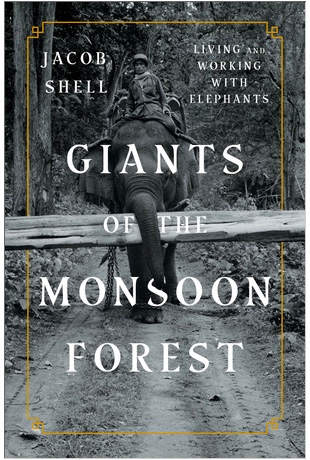
Giants of the Monsoon Forest by Jacob Shell

Geographer Jacob Shell delves deeply into the study of Asian elephants, largely to examine the longstanding human-elephant relationship that has existed over hundreds of years in southeast Asia.  While he gathered information from many historical texts on elephants, he also ventured deep into the remote forests of Burma, India and other countries to meet mahouts (riders) and their elephants.  In doing so, he created a wide-ranging commentary on animal behavior, geopolitics, history, wars, ethnic groups, and conservation.

The book is divided into thematic chapters covering the uses of elephants for logging, transportation, and war along with being pack animals for gems and military materiel. It shows that in the best circumstances (most often seen in the regions in Burma and India), there is a symbiotic relationship that is profiting the human “employers” while protecting elephants’ survival. 

Once trained, elephants have an eight-hour work day, then they are released into the surrounding forest to forage, to be with other elephants, and to mate.  Because humans move these working animals through areas where they might not go without assistance (for example, through populated areas), it allows elephants to mate with a wide group of wild elephants and keep a strong stock. 

Elephants’ intelligence is undeniable, and it is seen time and again through stories about their ability to problem solve, to make daring rescues, and to remember things from the distant past.  In addition, they also show tremendous compassion and understanding, as evidenced in numerous accounts from World War II, where—unbidden—elephants carried their deceased mahouts dozens of miles back to the mahouts’ homes.  It is these kinds of stories of animal behavior that are of most interest to me and which I could have read more about. 

Shell concludes with a chapter on the future of elephants, which he considers bleak.  Mahouts, and their understanding of elephants, could play a strong role in this future, but they are often left out of discussions on this topic as they are constrained by their animal charges in the forests. 

An excellent index makes this extremely valuable to researchers, as this book is aimed primarily at specialists rather than general readers.  There is so much to absorb, and the unfamiliar geography and language made it a more difficult read for me, who’s not as familiar with Asian history outside of China.  Still, there are fascinating chapters to read, and the research in the book is remarkable for its scope.  Readers who are interested in a particular topic, such as the use of elephants during the Vietnam War, could easily turn to that section and get a great account. 

General readers who want to know more about elephants and their behavior could start with Lawrence Anthony's The Elephant Whisperer: My Life with the Herd in the African Wild, although author Shell does point out the vast differences between these two species of elephants. 

Thanks to W.W. Norton and NetGalley for an advanced copy.  This will be published on June 11. 

Veil of Doubt by Sharon Virts

A story of a serial killing? Not my thing!  But I chose to give a new piece of historical fiction a try, and I discovered a fascinating co...