Sunday, June 9, 2019

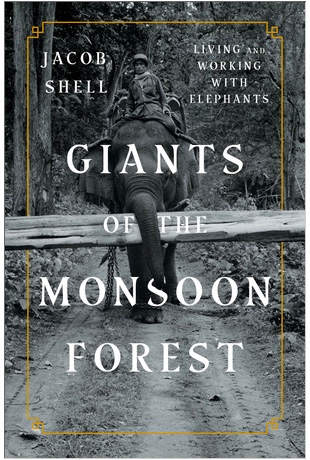
Giants of the Monsoon Forest by Jacob Shell

Geographer Jacob Shell delves deeply into the study of Asian elephants, largely to examine the longstanding human-elephant relationship that has existed over hundreds of years in southeast Asia.  While he gathered information from many historical texts on elephants, he also ventured deep into the remote forests of Burma, India and other countries to meet mahouts (riders) and their elephants.  In doing so, he created a wide-ranging commentary on animal behavior, geopolitics, history, wars, ethnic groups, and conservation.

The book is divided into thematic chapters covering the uses of elephants for logging, transportation, and war along with being pack animals for gems and military materiel. It shows that in the best circumstances (most often seen in the regions in Burma and India), there is a symbiotic relationship that is profiting the human “employers” while protecting elephants’ survival. 

Once trained, elephants have an eight-hour work day, then they are released into the surrounding forest to forage, to be with other elephants, and to mate.  Because humans move these working animals through areas where they might not go without assistance (for example, through populated areas), it allows elephants to mate with a wide group of wild elephants and keep a strong stock. 

Elephants’ intelligence is undeniable, and it is seen time and again through stories about their ability to problem solve, to make daring rescues, and to remember things from the distant past.  In addition, they also show tremendous compassion and understanding, as evidenced in numerous accounts from World War II, where—unbidden—elephants carried their deceased mahouts dozens of miles back to the mahouts’ homes.  It is these kinds of stories of animal behavior that are of most interest to me and which I could have read more about. 

Shell concludes with a chapter on the future of elephants, which he considers bleak.  Mahouts, and their understanding of elephants, could play a strong role in this future, but they are often left out of discussions on this topic as they are constrained by their animal charges in the forests. 

An excellent index makes this extremely valuable to researchers, as this book is aimed primarily at specialists rather than general readers.  There is so much to absorb, and the unfamiliar geography and language made it a more difficult read for me, who’s not as familiar with Asian history outside of China.  Still, there are fascinating chapters to read, and the research in the book is remarkable for its scope.  Readers who are interested in a particular topic, such as the use of elephants during the Vietnam War, could easily turn to that section and get a great account. 

General readers who want to know more about elephants and their behavior could start with Lawrence Anthony's The Elephant Whisperer: My Life with the Herd in the African Wild, although author Shell does point out the vast differences between these two species of elephants. 

Thanks to W.W. Norton and NetGalley for an advanced copy.  This will be published on June 11. 

Monday, June 3, 2019

Ayesha at Last by Uzma Jalaluddin

Welcome to the Toronto suburb of Scarborough, home of the cast of characters of Uzma Jalaluddin’s new novel that is a riff on Jane Austen’s Pride and Prejudice.  Ayesha Shamsi (Elizabeth Bennet) is 27 years old, almost “on the shelf” in terms of traditional Muslim marriages, and is an aspiring poet and reluctant high school English teacher.  This hijab-wearing woman is surrounded by her loving family, including her hard-working widowed mother, her Shakespeare-quoting grandfather, and her gentle grandmother.

Ayesha is especially indebted to her uncle, who has supported her family since the early death of her father, meaning that Ayesha lovingly obliges his requests for assistance with his younger, demanding, and very flighty daughter, Hafsa, who is determined to turn down at least 100 rishtas (marriage offers). 

Khalid Mirza is the Mr. Darcy equivalent, who observes Ayesha from afar, until circumstances—and a mutual friend—put them in each other’s way.  Khalid is a traditional, observant Muslim whose white robe and untrimmed beard represents his spiritual faithfulness; other people see him differently, including Ayesha who considers him as a “freak” and “bearded fundy.” His reserved demeanor is off-putting to many, the butt of jokes for his office mate and non-observant Muslim friend Amir, and the target of his new supervisor, Sheila “the Shark."  He is deeply challenged when the women from a successful lingerie company for plus-size figures specifically request him for the creation of their new website and online marketing.

Modern versions of Pride and Prejudice only succeed if they capture the flavor and intent of the original but offer the reader something new; Ayesha at Last succeeds on both counts.  The author skillfully creates a main couple who have their own prejudices about marriage, about religion, about life goals, and need to work them out as they dance around a relationship that stretches the bounds of propriety (in a conservative Muslim way).  The novel, like P&P, describes a specific time and place and community that is strongly occupied with idea of marriage and the roles of men and women, expressed in multiples ways by many different characters.

But you don’t need to know anything about Austen’s novel to enjoy this one; it works on so many levels.  It has a really strong plot line, as well as humor, and a vast array of characters who show how diverse and varied the Muslim world is (one of my favorite characters was the Hawaiian-shirted imam). The Muslim life-style is interesting to read about and consider, and the novel contains thoughts on immigrants, the universal issue of falling attendance in religious communities, and religious prejudices.  The Canadian setting adds another dimension and a fresh perspective to this entire mix.

To be published June 4 by Penguin Random House.

The novel was optioned by Pascal Pictures, home to Spider-Man, The Post, and the forthcoming Little Women.

https://www.uzmajalaluddin.com/

Wednesday, May 29, 2019

The Spies of Shilling Lane by Jennifer Ryan

It's an achievement to come up with something new and fresh in a historical fiction genre that is bursting at the seams (specifically, WW II fiction set in England). Some of my favorites are The Guernsey Literary and Potato Peel Pie Society by Mary Ann Shaffer and Annie Barrows, Dear Mrs. Bird by A. J. Pearce, Mr. Churchill’s Secretary by Susan Elia MacNeal, and this author’s first novel The Chilbury Ladies’ Choir

Books set in England during this time period tend to be much different than ones set in Europe, in part because there is that keen focus on a smaller, unoccupied location where people lived  understated lives with can-do attitudes that helped them overcome the Blitz, rationing, and shortages. 

The author does that in her second novel by focusing on Mrs. Braithwaite, a rather unlikable middle-aged woman whose life is challenged and changed when she is no longer the reigning Queen Bee in her small country village and whose worry for her daughter Betty forces her to step outside her comfort zone.  She travels to London to see about her missing daughter, ostensibly with a job at the sewage works in London, and to give her what-for for not corresponding regularly. 

Barging into Betty’s rooming house on Shilling Lane, she immediately starts bossing its residents around, including the timid landlord Mr. Norris, a hesitant little man who is her contemporary.  In her search for the missing Betty, Mrs. Braithwaite sniffs out circumstances that are not as they should be, and that sets lively activities into motion.

While falling into "women's fiction" category, the book contains excellent scenes of wartime London and subversive groups working against the British government.  It is flavored by interesting characters, a fair amount of suspense, and some very funny descriptions.   Of course, no one is as they seem, and our Mrs. Braithwaite grows on the reader as well as on other characters, as she takes things into her own capable hands and starts seeing the world in new ways. 

One of my favorite quotes from the novel captures some of the flavor of the story:

     "You saw the European history books on Baxter's shelf. And the philosophy!" She [Mrs. Braithwaite] stood up, leaning across the card table. "Anyone who reads philosophy is bound to be suspicious."
     "Why is that precisely?" Mr. Norris said, affronted. "I'm partial to a spot of philosophy myself. Just because someone wants to consider other ways of thought, it doesn't make them evil."
     "It's unbiblical, not to mention un-British.”

Advance copy courtesy of Netgalley.  To be published on June 4 by Crown Publishing.
https://www.jenniferryanauthor.com/the-spies-of-shilling-lane

Sunday, May 19, 2019

"Searching for Sylvie Lee" by Jean Kwok

The disappearance of a beloved older sister, Sylvie Lee, and the search for her by her younger sister Amy is the ostensible plot of Jean Kwok’s newest book.   But we are told in the first chapter that Amy admires the quote by Willa Cather: “The heart of another is a dark forest, always, no matter how close it has been to one’s own.”

Amy gathers the courage to travel alone to The Netherlands to look for her accomplished older sister who traveled there a month prior to visit their dying grandmother, a woman Amy has never met, but who raised Sylvie in her first nine years of life.  Sylvie was sent to Holland due to her parents’ dire economic circumstances, but she returned to her parents at the age of nine to help take care of two-year-old Amy.  Amy adores her, and Sylvie’s disappearance with no word is unlike anything that she has ever done. 

Amy arrives in Holland with no understanding of Dutch or of the Dutch culture, which is so unlike her own upbringing in New York City.  She meets her mother’s cousin Helena, her husband Willem, and their son Lukas, who is Sylvie’s age and who grew up with her, along with Lukas’ and Sylvie’s Dutch friends, Filip and Estelle.  Amy is perplexed by this family she has never met but who had such a big influence on her sister’s life.  She is frustrated by the Dutch police, who don’t take her missing person’s report seriously, and she is mystified by Lukas’ assurance that Sylvie is fine and that she is just thinking things through. 

The story unfolds like a peeling onion, with chapters from the perspectives of Amy, Ma, and Sylvie, and we discover that family secrets are a dangerous thing, and they abide in multiples in this family of immigrants.  They are slowly revealed to Amy — and to the reader.

One of the great strengths of this book is the portrayal of the immigrant experience, with the longing for home and the need to fit into a culture that is inscrutable and often unfriendly.  It is made more complex by the situation of two families in two foreign cultures, and there are wonderful descriptions of individuals meeting and bumping up against these cultures.  The author does a fine job of highlighting these cultures through the use of language, and each character speaks English in a way that shows his or her own background—Ma with flowery phrases but awkward sentence structure, Amy as an American, Sylvie in Holland with phrasing that is obviously an English translation of Dutch (her native language). 

At one point, Ma says of Sylvie and Amy: “There descended such a barrier between me and my daughters, like a curtain through which you could only vaguely make out the figures on the other side.  The Brave Language [English] belonged to the devil with all of its strange consonants, a puzzle I could not solve, and they were constantly chattering in it: stories, joys, and pains.  I desperately tried to understand.  I never could.  I could not reach them and they barely noticed me.  I asked them to speak Central Kingdom talk but they ignored me as if I had been playing the lute for a cow.”

While the plot seems a little overwrought at times, the ideas that Kwok puts forth about families and their relationships, love and its complexities, and the hard life of and prejudices shown to immigrants are compelling and would make for excellent book discussion.  The description of life in Holland is fascinating, and the imagery of open and closed curtains in houses nicely captures the themes of the novel. 

To be released on June 4. 
Thanks to Netgalley and Harper Collins for an advance copy.  (Quotes are not from the finished copy.)


.

Saturday, April 27, 2019

The Stone Circle by Elly Griffiths

The lonely stretches of marshland on England’s coast in county Norfolk are home to forensic archeologist Ruth Galloway, who first appeared in The Crossing Places in 2010.  This is the eleventh entry in the mystery series by Elly Griffiths, and it circles back to the first book through similar themes, characters, and plot lines. 

Ruth, who is a lecturer at a local university, is sometimes called in by the local police force to evaluate the bones found in local digs or criminal investigations.  She is a meticulous researcher, a loner, and somewhat bristly, but she is drawn to Detective Chief Inspector (DCI) Harry Nelson—both professionally and personally—creating a complicated relationship and a difficult problem for this married father of two adult children and most recently, a newborn.

The Stone Circle opens with DCI Nelson and Ruth receiving threatening letters in the vein of ones sent to them a decade before—but the problem is that the original sender is long-since dead.  Those, along with the discovery of two skeletons at a newly found stone ring, bring the two together to look into an archeological mystery and a missing-child case from twenty years before. 

This is an excellent police procedural that is strengthened by its atmospheric setting and archeological details, as well as by the the strong characterizations of Ruth and Nelson (who now have an 8-year-old daughter); their charged relationship adds tension to the suspenseful story. The secondary characters shine in their own right.  Nelson’s staff is fully fleshed out and includes the maternal DS Judy Johnson and the hilarious millennial DS Dave Clough. In addition, there is the local druid Cathbad, the visiting Norwegian archeologist Leif Anderssen, Nelson’s family, and the extended family whose daughter mysteriously disappeared; they all add much to the story. 

One of the things that makes the book so interesting is that local lore, Bronze Age information, nods to the political scene of 2016, references to classic literature and to Harry Potter are woven throughout the pages.  Because the book is full of people who are continuing characters or who are past characters related to this current plot, I would recommend reading this series in order to appreciate it fully. 

Highly enjoyable reading for people who like the books written by such authors as Erin Hart, Julia Spencer-Fleming, or Deborah Crombie,

Published on May 7.  Advanced copy from NetGalley.

Wednesday, April 17, 2019

The Book Woman of Troublesome Creek

Works Projects Administration - http://newdeal.feri.org/library/i15.htm
Images of the WPA librarians who carried books into rural areas during the Depression have been cropping up on Facebook recently, and they have piqued my interest in this early mobile library service, so I was intrigued to see this new novel coming out on May 7 by Kim Michele Richardson, herself a resident and scholar of Kentucky.

A couple pages in, and I feared that The Book Woman was heading into cornpone Beverly Hillbillies territory, but how wrong I was.  This story of Cussy Mary Carter, a “book woman” for the WPA in the hills of Kentucky during the Great Depression, tells about the heroic efforts of the real library women (and a few men) who traveled on horses or mules at great peril to deliver books, old newspapers, magazines, homemade scrapbooks of recipes and local folk remedies to people in the eastern hills of “Kaintuck” who were literally starving—for food, but also for reading material, letters, news, and stories that delivered hope, information, and entertainment.
Author Kim Michele Richardson deftly puts people’s speech patterns into the local dialect and intimately describes the hardscrabble life of people who were eking out livings by coal mining and subsistence farming in the dark and barren hollers.  But even more, she richly describes the customs and folklore of the region, the treacherous pathways to get to mountain schools and remote cabins, and the rare (and actual) blood disorder that affects Cussy Mary and her family and turns their skin blue, making them “colored” and subject to prejudice, isolation, and persecution.

How do people—and particularly, Cussy Mary and her family—survive and thrive in a time of hard living and isolation, prejudice, illiteracy, enslavement by coal companies and the resulting environmental issues and black lung disease?  These are all interwoven into an immersive story that is suspenseful, heartbreaking, and hopeful.  This corner of America in the 1930s is brought to life in a brilliant way, with so much to think about and to discuss.

Put this at the top of your list as it’s historical fiction at its finest.  The author's webpage provides information on her books: https://www.kimmichelerichardson.com/
Check out the giveaway on Goodreads!

Veil of Doubt by Sharon Virts

A story of a serial killing? Not my thing!  But I chose to give a new piece of historical fiction a try, and I discovered a fascinating co...