Saturday, May 2, 2020

Beach Read by Emily Henry

(The pandemic has turned the publishing world upside down, but Beach Read by Emily Henry appears to be coming out as planned on May 19  from Penguin Random House). 

January Andrews writes women's fiction; Augustus Everett writes literary fiction. The two had a love/hate relationship in college when January knew him as Gus and when his seemingly arrogant attitude and critical commentary of her work cooled other feelings for this guy she and her friend nicknamed Sexy, Evil Gus (or SEG for short).  He sees her as the fairy princess of all sweetness and light, she views him as the angsty, brooding writer who sees only the dark side. 

Now, several years later, they are published authors, hitting the bestsellers list at the same time, although Gus is, disturbingly, three slots ahead of January.  They are also both having major writers' blocks, and when January runs short of funds as well as ideas, she heads out to the vacation town in Michigan to the house her late father left her...right next door to Sexy, Evil Gus.

Well, what could go wrong--or right?  Their "reunion" meeting at the local bookstore is anything but cordial, and their attendance at the evening's book discussion takes their relationship to new lows.  But, it does prompt them to place a bet that may restart their writing.  January challenges Gus to write a rom-com and he dares her to write literary fiction.  Going along with the bet are educational evenings for research and ideas on character and plot development, how romance is started and how to understand the bad things that happen to people.

Their conversations are snarky and flirty, and the first half of the book does read like a rom-com, but it changes about halfway through as serious and darker themes are explored as they relate to the lives of each of them, both personally and professionally.

This is an entertaining, page-turning and unusual story that has fun references to popular authors and some great secondary characters including a true eccentric who runs the local bookstore.  There literally IS a beach read here, but not in the way that they are generally understood. 

Thanks to Edelweiss and the publisher for an advance copy.

Thursday, April 9, 2020

The Jane Austen Society by Natalie Jenner

(Releases May 26) This lovely novel by debut author Natalie Jenner imagines how a group of people who cherish the works of Jane Austen find each other and propose a special society to honor the beloved author in the small village of Chawton, Hampshire. 

Few groups could be as diverse in personality and circumstance as the one that gathers right after World War II.  There’s a bachelor farmer, a country doctor, a respected solicitor, a young widowed teacher, a high school dropout, an Austen descendent from the Knight family, a Sotheby’s representative, and an American movie star.  While some of the group have known each other since childhood, others meet serendipitously through their appreciation of Jane Austen’s works.

In the first chapter, so beautifully described, a young farmer stretches out on a churchyard wall to rest after early morning labors.  He is interrupted by a chic American woman who is looking for the home of Jane Austen.  Her admiration of this author, from this very village, encourages him to read her novels, where he finds a kindred spirit and hope in a seemingly hopeless world of death (his two brothers were killed in WWI, his father in the Spanish flu) and loneliness.

A young teacher at the school, forthright and confident, loves teaching her students the works of Austen until she is challenged by the all-male school board, is widowed within one year of marriage and loses her baby at birth.  A middle-aged woman sits in the ancestral home, surrounded by beloved objects related to the Austen family, but is totally intimidated by her domineering father who is on the edge of death.

Each character faces his or her own challenges, often of immense loss or lack of understanding, and each finds consolation in the Austen novels.  When they gather to think about how to pay tribute to their favorite author, they have to overcome some long odds, involving money, last-minute wills, and unscrupulous real estate deals—not to mention getting past their own shortcomings and personal challenges. 

This is a life-affirming novel that is quiet and hopeful and pays great tribute to an author and her works with many quotable sentences and paragraphs about the power of literature.  It is set apart from many Austen adaptations by its time period, plot, and cast and reminds me of one of my favorite novels about a group of readers, The Guernsey Literary and Potato Peel Pie Society.  Highly recommended, especially during these discomforting times. 

Thanks to Netgalley and St. Martin's Press for an advance copy.

Thursday, April 2, 2020

Hid from Our Eyes by Julia Spencer-Fleming

In 2005, local readers (in western New York) were introduced to Julia Spencer-Fleming, whose first novel In the Bleak Midwinter was the title for the one-book program called "A Tale for Three Counties."  That visit and book started a devotion to this author who has consistently provided interesting and topic-filled mysteries starring Episcopal priest Clare Fergusson and Police Chief Russ Van Alstyne.  Hid from Our Eyes (Minotaur Books), her ninth book in the series is out on Tuesday, April 7.  It’s another outstanding mystery that showcases the strengths of this writer and proves why she has such a loyal following. 

The book opens in 1952 with the discovery of a young woman’s body on the remote McEachron Rd. in the small Adirondack township of Cossayuharie.  Wearing a party dress and nicely groomed, she is missing her shoes, stockings, and purse with no signs for a cause of death.  In 1972, another corpse is discovered, same location, same conditions, same time of year.  Then fast forward to the present, when a third young woman’s body is found in the exact way, and Chief Van Alstyne is now in charge of the investigation. He has ties to the previous unsolved death—and not in a good way—as he was the scruffy young Vietnam vet, just home from the war, who discovered the body.

These unexplained deaths propel the mystery.  Circling through three time periods, the story also involves the current issues of the Millers Kill Police Department which is facing a town referendum on dissolving the force.  Committed to providing a safe community, Russ is also concerned for the members of his staff who need their jobs to survive.  Facing a particularly difficult situation is Officer Hadley Knox, a single mother who has returned to Millers Kill to provide a stable home life for her children and to look out for her grandfather, but whose dubious past is exposed to her fellow officers by her vengeful ex-husband.  As if that wasn’t enough, the department is hit with a lawsuit alleging that she and former MKPD Officer Kevin Flynn roughed up her ex-husband and planted drugs in his suitcase.

Despite the distractions, Russ focuses his department on searching for answers to the death of this unknown subject, knowing they face particular public scrutiny at this time while also acknowledging that they are grasping at straws.  Their legwork takes them several places, revisiting people of interest from 1972, looking into local resorts and restaurants, following up on cell phone use, and going to check out the itinerant carnival workers at the the annual Washington County Fair.  At the fair, the absent Officer Flynn surfaces, as he is working undercover investigating domestic extremism for his new job with the Syracuse PD. 

Meanwhile at home, Russ is settling into newly married life with Clare and their baby son Ethan.  Clare is having trouble adapting to motherhood, trying to do too much and not willing to accept enough help from caregivers and her mother-in-law.  Her stress provides some real challenges to her mental health and her ongoing struggle with substance abuse, but she soldiers on, reaching out to people in need, continuing her parish duties, and taking on a new seminary intern who provides entry into the community of monied seasonal residents and their interest in the Save Our Police campaign. 

There’s a lot going on here with themes of misogyny, tax cuts, PTSD, cold cases, community policing, and transgendered people, but it is skillfully handled and woven seamlessly into the story.  Some of it is fairly melancholy as the demons of past lives and the pressures of current ones weigh heavily on many characters.  Fortunately, it is leavened with the author’s trademark humor, which can be ironic and witty.  The bantering among the officers and between Russ and Clare, the misunderstandings across generational divides, and the characters’ hidden thoughts and asides are lots of fun. The inclusion of hilarious moments between Russ and a certain Snoopy tie-wearing reporter, based on the Daily News’ own editor Ben Beagle, is laugh-out-loud funny.

This may be the longest book in the series, but it is as creative and fresh as the first book with a maturity in writing.  Short chapters, moral dilemmas, familiar characters, and a complex mystery make this compelling reading.  I’ve read the book twice, and I can say that the resolution to the mystery is exceptionally clever and unusual but that the clues are provided with fairness.  It ends on a cliffhanger that involves not one, but two of the characters’ stories. 

It’s been six years since Julia’s last book was published, in part because she is a self-admittedly slow writer and in part because of the illness and death of her husband. Her oldest daughter, a columnist for a Maine newspaper, reports that Julia is weathering the current coronavirus crisis by sitting at her kitchen table and working on her next book, which is good news for all of us.


(Thanks to the publisher and BookishFirst.com for an advance copy of the book.)

Tuesday, February 25, 2020

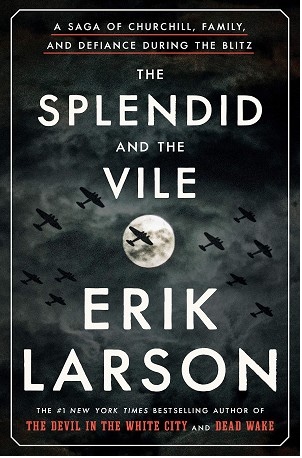
The Splendid and the Vile by Erik Larson

Although I’m not done with this book, I wanted to mark its publication date with a special but short message: Read it!

While I have learned about WW II in school and have read many novels set during this time period, I don’t think that I ever grasped the extremely precarious position that Great Britain found itself in at the start of 1940.  Most of Europe had fallen, and Hitler had his eye on the British Isles for his next conquest.

In Larson’s account, Winston Churchill’s tremendous resolve is the characteristic that shines through during his first year as prime minister, which also coincided with Great Britain’s entry into World War II.  How close to complete annihilation this country stood is breathtaking, and the war would have gone very differently without the courageous leadership of this man.

This is a hefty volume that covers just this one year, but it is a compelling account of the time, since it includes much personal information, with writings from Churchill’s secretaries, as well as diaries and letters from Churchill’s family, particularly his youngest child Mary who was 17 at the time; from common people, some of whom wrote for a special governmental project documenting the war; from statesmen who were working for Churchill; from war correspondents; and from Germans, including the combat pilot and flying ace Adolf Galland. 

There are glorious descriptions of people watching the air battles from behind their curtains at night, sitting in their gardens or lying in fields near the English Channel.  Larson has created a very strong sense of being there, contrasting the terrible beauty of it all.  The title of the book comes from Churchill’s young secretary John Colville, who described the amazing lights and flashes of London being bombed with the utter devastation that followed.

Perhaps what makes it so intensely readable is the combination of military information with the mundane details of daily life, such as how people relied on tea for sustenance and the strength to deal with the trauma of living in a war zone.

Hitler’s plan for Britain was to get them to surrender—to accept a peaceful treaty—without the war in the air that ended up happening.  What Churchill accomplished is jaw-dropping.  Put it on your reading list!

Thanks to Netgalley and Crown Publishing for an advance copy.

Saturday, February 8, 2020

Eden Mine by S.M. Hulse

In 2016, S.M. (Sarah) Hulse was the fourteenth and final author for the one-book program “A Tale for Three Counties,” sponsored by the libraries in Genesee, Orleans, and Wyoming Counties (NY).  In her talks at Genesee Community College, at area libraries, and in two high school classes, she spoke about being interested in the aftermath of big events and in decent people who make painful mistakes.  Her new novel, being published on Tuesday, February 11 by Farrar, Straus, Giroux, takes these ideas and explores them in brilliant ways.

    From its first line—“My brother’s bomb explodes at 10:16 on a late April Sunday morning.”—S.M. Hulse’s new novel Eden Mine continues dropping figurative bombshells in her story of Jo Faber and her beloved brother Samuel in the small town of Prospect, Montana.

    Jo and Samuel have been orphaned and have lived a life unfair in its cruelty, including the death of their father in a mine collapse and their mother in a way that unfolds throughout the story.  Their most recent devastation is the impending loss of their family home, being sold through eminent domain for the construction of a new road that will bypass—rather than repair —the recent land erosion over Eden Mine.  

    When Sheriff Hawkins appears at Jo’s door to tell her that Samuel has been caught on video camera at the county courthouse right before the bomb explodes, she is not entirely surprised, as he has had a history of following crackpot conspiracy theories and extremist ideologies.  The horrifying thing to her is that people have been wounded while worshipping in a storefront church nearby, including a young girl in critical condition; Jo is sure that this is unintended on Samuel’s part as he has tenderly cared for her through recent years of her own special needs.  So starts the dance between Jo and Sheriff Hawkins, a family friend who has assisted them during the tough times, and between Jo and Will Devin, the FBI agent who asks her deeply unsettling questions about her brother’s motivations and where he could be.

    Besides the obvious destruction, the bomb also causes other things to happen, like propelling Jo out of her safe and narrow world into the town of Elk Fork to attend the prayer vigil for Emily, the young daughter of the church’s pastor Asa Truth.  There, she has to confront the ugly reality of what Samuel has done as well as the anger of people who recognize her and blame her for his actions.  She also meets Asa Truth, who reaches out in Christian charity, beginning a tentative friendship.

    The book is told in the first person by Jo with brief sections narrated by Samuel (as a letter to Jo written on a road map) and by Asa (as conversations with God).  It is a highly effective method of telling the story, and the slow revelations about Jo and Samuel and Asa make it deeply compelling.

    As in S.M. Hulse’s first novel Black River, the author uses art to reveal her main character.  In this novel, Jo is a painter whose experimentation with her artistic style shows personal growth and an evolving comprehension of the world.  Also like her first novel, there are wonderful descriptions of Jo’s mule Lockjaw, which highlight Hulse’s understanding of horses and their relatives. 

    The best part may be the way that the story is concluded, since the reader knows that a showdown is inevitable.  The whole thing is beautifully done and rightfully will be a favorite of book discussion groups who will enjoy the character development and the themes of art, faith, morality, and paralysis, set within the wide spaces and dying towns of Montana.  

This review also appears in the 2/8/2020 edition of The Daily News, Batavia, NY.

Thanks to Netgalley and FSG for an advance copy.

Monday, January 27, 2020

The Operator by Gretchen Berg

“Garsh,” as Vivian Dalton would say, this was unexpected.  Gretchen Berg’s debut novel is set in 1952 in small-town Wooster, Ohio and is about secrets that, once uncovered, cannot help but disrupt the lives of the people they are about. 

Vivian, the wife of Edward and mother of teenager Charlotte, has her finger on the pulse of Wooster due to listening in on conversations in her capacity as a telephone operator.  Petty jealousies with her older sister Vera and classmate Betty Miller create seemingly huge tensions, which are really nothing compared to the news that Vivian accidentally overhears one evening on her shift at work. 

The problem with secrets is that they not only expose a truth about someone else, but they also color your own presumptions about who you are.  After Vivian discovers the secret about her own family, it sets into motion her own clandestine path to get to the bottom of things.  Berg does this really well in her novel, and she shows an organic growth in her character that is not only believable but heart-warming. 

In one amusing scene, set over a series of pages, the reader is introduced to the character of Vivian before her transformation. Here, Vivian takes great exception to Charlotte’s reading of The Myth of Sisyphus for her English class…so much so that it sets Vivian on a tirade with Charlotte (“‘YOU WILL NOT BRING PORNOGRAPHY INTO THIS HOUSE!’”) and a visit to school. 

Charlotte had been stupefied by her mother’s deranged outburst and it had taken her several minutes to understand the cognitive disconnect.  Her mother had been so enraged that Charlotte couldn’t explain the mistake to her, and had just gone up to her room with the remaining shreds of the book.  She had then been flooded with dread, imagining her mother taking her Rage, with a capital R, to the high school, stomping in with hair and eyes wild, pocketbook swinging like a weapon, demanding to speak to the filth-monster who gave her daughter pornography.
Charlotte had had to wait until the next morning at breakfast, when her mother was calmly drinking her coffee, to explain that Sisyphus was a Greek king and not a venereal disease.

I started reading the novel and thought that it was going to be one long mid-western riff on Heehaw, but it is a lovely, folksy slice of life with revelations that keep the pages turning.  The author has a knack for describing social situations in entertaining and authentic ways, while providing perspectives from several points of views.  Vivian, who is so young and simple in the beginning (since we see her as a high-schooler and newly married woman),  evolves believably from a closed-minded person to a woman who discovers how to discern what is right for her life.

Places like Beulah Bechtel’s Dress Shop, the Friedlander department store and other Wooster sites were still a big part of Wooster life when I was a college student in the mid-70s, and they are authentic but richly enough described for readers who have never been there.  Nods to 1950s pop culture, the working of the telephone office, the hilarious dialogue, and the use of details that were inspired by family stories (with recipes that contain misspellings and wonderful asides) and articles in the Wooster newspaper, all add up to a new author not to miss.

Keep this on your “to read” pile—it comes out on March 10.  Thanks to Edelweiss and HarperCollins for an advance copy.

Tuesday, December 3, 2019

"Would Like to Meet" and "The Clergyman's Wife"

Two novels coming out today are seemingly quite different but share many of the same qualities.  Would Like to Meet, a contemporary romance by Rachel Winters and The Clergyman’s Wife, historical fiction by Molly Greeley are both inspired by other material—in the first case, it’s romantic comedies in film and in the second, Pride and Prejudice by Jane Austen.  Both feature young women with romantic possibilities who are finding themselves; both young women’s lives are influenced by their fathers, either by having a parent who encouraged his daughter’s pursuits or by having a parent whose newfound claim-to-fame blinds him to the economic effect on his female offspring.  Both young women work to make the best of the situations they find themselves in within these novels written by debut authors.

In Would Like to Meet, assistant film agent Evie Summers seems to be destined to remain in that lowly position even though she aspires to be an agent—and maybe even a screenwriter.  She is a hard worker, but her boss and owner of the agency takes advantage of her good nature, because she is willing to take on any task to prove herself. 

When Evie agrees to deal with the most difficult client in the agency, Ezra Chester, who is also a dashing award-winning screenwriter, she must convince him that writing a romantic comedy is not beneath him AND that romantic comedies describe possible real-life scenarios.  Trying to inspire him to write the rom-com script that he was contracted for, Evie agrees to set up her own meet-cutes and write about them to get his creative juices flowing; she must prove that this is viable by finding someone in time for her best friend’s wedding.

Using scenes out of her favorite movies like "Notting Hill" and "You’ve Got Mail," Evie meets men with often hilarious results.  Her trio of friends provide moral support through entertaining group e-mails and periodic get-togethers while planning for their one (demanding) friend’s “hen party.”  Meanwhile, a widowed dad and his precocious daughter witness Evie’s first attempt at meeting someone in the local coffee shop and entwine themselves in her life with perceptive conversations, assistance, and misunderstandings.

The story has some very sweet moments and some that make you laugh while cringing (a little bit), but the cast of characters is wonderful, and it’s a fun look at a woman coming into her own.

In The Clergyman’s Wife, Molly Greeley tackles an Austen character who seems least likely to be a protagonist in a novel.  Charlotte Lucas, Elizabeth Bennet’s friend in Pride and Prejudice, is the woman who darts in after Elizabeth’s rejection of the obsequious vicar and marries him as a way to become a semi-independent woman with a home of her own. 

Charlotte, now Mrs. Collins, celebrates the small joys of life in the village of Hunsford, presided over by the overbearing Lady Catherine de Bourgh.  Charlotte’s greatest delight is her little daughter Louisa who acts as a tiny mediator with the villagers who are part of Mr. Collins’ flock.   Reaching out to people who are lonely, sick or poor, Charlotte develops friendships beyond the exalted walls of de Bourghs’ home at Rosings Park.  This way, she meets Mr. Travis, a farmer who piques her interest, who shares her concerns, and who seems to invade her thoughts in ways that a man has never before.

Some of the great strengths of this story are the beautiful writing, the characterization of Charlotte, and the depictions of everyday life in this small section of England in the early 1800s.  Charlotte’s thoughtful observations about herself and her life choices makes a wistful narrative about a woman’s life. 

Between Charlotte’s first person perspective and the imagery the author uses to create sensory experiences of the woods, the gardens, the weather, and the homes, there is an immediacy that brings the reader into the story.  Here is one example: “The dining room at Rosings is lit by dozens of candles, but still it is so vast that much of the room remains in darkness, the footmen lining the walls merely man-shaped shadows except when they step forward to pour wine.  The candles do, however, illuminate the gleaming table settings and platters of rich foods, and cast the faces of my dining companions in a light that gentles all of their profiles and makes even William almost handsome.” (page 132)

The story is resolved in the only way that it could be, but like the novel above, it allows the main character to have agency and to realize her self-worth.  The novels are published today, December 3. 

Thanks to the publishers and to Edelweiss for advance copies.

Rachel Winters, Would Like to Meet (Penguin Random House)
Molley Greeley, The Clergyman's Wife (Harper Collins)


Veil of Doubt by Sharon Virts

A story of a serial killing? Not my thing!  But I chose to give a new piece of historical fiction a try, and I discovered a fascinating co...