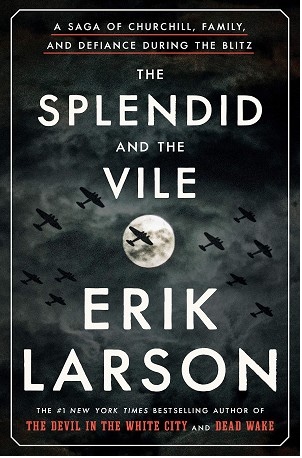
Although I’m not done with this book, I wanted to mark its publication date with a special but short message: Read it!
While I have learned about WW II in school and have read many novels set during this time period, I don’t think that I ever grasped the extremely precarious position that Great Britain found itself in at the start of 1940. Most of Europe had fallen, and Hitler had his eye on the British Isles for his next conquest.
In Larson’s account, Winston Churchill’s tremendous resolve is the characteristic that shines through during his first year as prime minister, which also coincided with Great Britain’s entry into World War II. How close to complete annihilation this country stood is breathtaking, and the war would have gone very differently without the courageous leadership of this man.
This is a hefty volume that covers just this one year, but it is a compelling account of the time, since it includes much personal information, with writings from Churchill’s secretaries, as well as diaries and letters from Churchill’s family, particularly his youngest child Mary who was 17 at the time; from common people, some of whom wrote for a special governmental project documenting the war; from statesmen who were working for Churchill; from war correspondents; and from Germans, including the combat pilot and flying ace Adolf Galland.
There are glorious descriptions of people watching the air battles from behind their curtains at night, sitting in their gardens or lying in fields near the English Channel. Larson has created a very strong sense of being there, contrasting the terrible beauty of it all. The title of the book comes from Churchill’s young secretary John Colville, who described the amazing lights and flashes of London being bombed with the utter devastation that followed.
Perhaps what makes it so intensely readable is the combination of military information with the mundane details of daily life, such as how people relied on tea for sustenance and the strength to deal with the trauma of living in a war zone.
Hitler’s plan for Britain was to get them to surrender—to accept a peaceful treaty—without the war in the air that ended up happening. What Churchill accomplished is jaw-dropping. Put it on your reading list!
Thanks to Netgalley and Crown Publishing for an advance copy.
Reviews from the sunny side of the street! Positive reviews of upcoming books, mostly fiction and some non-fiction. View more at my Instagram page @leslie_stitches
Tuesday, February 25, 2020
Saturday, February 8, 2020
Eden Mine by S.M. Hulse
In 2016, S.M. (Sarah) Hulse was the fourteenth and final author for the one-book program “A Tale for Three Counties,” sponsored by the libraries in Genesee, Orleans, and Wyoming Counties (NY). In her talks at Genesee Community College, at area libraries, and in two high school classes, she spoke about being interested in the aftermath of big events and in decent people who make painful mistakes. Her new novel, being published on Tuesday, February 11 by Farrar, Straus, Giroux, takes these ideas and explores them in brilliant ways.
From its first line—“My brother’s bomb explodes at 10:16 on a late April Sunday morning.”—S.M. Hulse’s new novel Eden Mine continues dropping figurative bombshells in her story of Jo Faber and her beloved brother Samuel in the small town of Prospect, Montana.
Jo and Samuel have been orphaned and have lived a life unfair in its cruelty, including the death of their father in a mine collapse and their mother in a way that unfolds throughout the story. Their most recent devastation is the impending loss of their family home, being sold through eminent domain for the construction of a new road that will bypass—rather than repair —the recent land erosion over Eden Mine.
When Sheriff Hawkins appears at Jo’s door to tell her that Samuel has been caught on video camera at the county courthouse right before the bomb explodes, she is not entirely surprised, as he has had a history of following crackpot conspiracy theories and extremist ideologies. The horrifying thing to her is that people have been wounded while worshipping in a storefront church nearby, including a young girl in critical condition; Jo is sure that this is unintended on Samuel’s part as he has tenderly cared for her through recent years of her own special needs. So starts the dance between Jo and Sheriff Hawkins, a family friend who has assisted them during the tough times, and between Jo and Will Devin, the FBI agent who asks her deeply unsettling questions about her brother’s motivations and where he could be.
Besides the obvious destruction, the bomb also causes other things to happen, like propelling Jo out of her safe and narrow world into the town of Elk Fork to attend the prayer vigil for Emily, the young daughter of the church’s pastor Asa Truth. There, she has to confront the ugly reality of what Samuel has done as well as the anger of people who recognize her and blame her for his actions. She also meets Asa Truth, who reaches out in Christian charity, beginning a tentative friendship.
The book is told in the first person by Jo with brief sections narrated by Samuel (as a letter to Jo written on a road map) and by Asa (as conversations with God). It is a highly effective method of telling the story, and the slow revelations about Jo and Samuel and Asa make it deeply compelling.
As in S.M. Hulse’s first novel Black River, the author uses art to reveal her main character. In this novel, Jo is a painter whose experimentation with her artistic style shows personal growth and an evolving comprehension of the world. Also like her first novel, there are wonderful descriptions of Jo’s mule Lockjaw, which highlight Hulse’s understanding of horses and their relatives.
The best part may be the way that the story is concluded, since the reader knows that a showdown is inevitable. The whole thing is beautifully done and rightfully will be a favorite of book discussion groups who will enjoy the character development and the themes of art, faith, morality, and paralysis, set within the wide spaces and dying towns of Montana.
This review also appears in the 2/8/2020 edition of The Daily News, Batavia, NY.
Thanks to Netgalley and FSG for an advance copy.
From its first line—“My brother’s bomb explodes at 10:16 on a late April Sunday morning.”—S.M. Hulse’s new novel Eden Mine continues dropping figurative bombshells in her story of Jo Faber and her beloved brother Samuel in the small town of Prospect, Montana.
Jo and Samuel have been orphaned and have lived a life unfair in its cruelty, including the death of their father in a mine collapse and their mother in a way that unfolds throughout the story. Their most recent devastation is the impending loss of their family home, being sold through eminent domain for the construction of a new road that will bypass—rather than repair —the recent land erosion over Eden Mine.
When Sheriff Hawkins appears at Jo’s door to tell her that Samuel has been caught on video camera at the county courthouse right before the bomb explodes, she is not entirely surprised, as he has had a history of following crackpot conspiracy theories and extremist ideologies. The horrifying thing to her is that people have been wounded while worshipping in a storefront church nearby, including a young girl in critical condition; Jo is sure that this is unintended on Samuel’s part as he has tenderly cared for her through recent years of her own special needs. So starts the dance between Jo and Sheriff Hawkins, a family friend who has assisted them during the tough times, and between Jo and Will Devin, the FBI agent who asks her deeply unsettling questions about her brother’s motivations and where he could be.
Besides the obvious destruction, the bomb also causes other things to happen, like propelling Jo out of her safe and narrow world into the town of Elk Fork to attend the prayer vigil for Emily, the young daughter of the church’s pastor Asa Truth. There, she has to confront the ugly reality of what Samuel has done as well as the anger of people who recognize her and blame her for his actions. She also meets Asa Truth, who reaches out in Christian charity, beginning a tentative friendship.
The book is told in the first person by Jo with brief sections narrated by Samuel (as a letter to Jo written on a road map) and by Asa (as conversations with God). It is a highly effective method of telling the story, and the slow revelations about Jo and Samuel and Asa make it deeply compelling.
As in S.M. Hulse’s first novel Black River, the author uses art to reveal her main character. In this novel, Jo is a painter whose experimentation with her artistic style shows personal growth and an evolving comprehension of the world. Also like her first novel, there are wonderful descriptions of Jo’s mule Lockjaw, which highlight Hulse’s understanding of horses and their relatives.
The best part may be the way that the story is concluded, since the reader knows that a showdown is inevitable. The whole thing is beautifully done and rightfully will be a favorite of book discussion groups who will enjoy the character development and the themes of art, faith, morality, and paralysis, set within the wide spaces and dying towns of Montana.
This review also appears in the 2/8/2020 edition of The Daily News, Batavia, NY.
Thanks to Netgalley and FSG for an advance copy.
Monday, January 27, 2020
The Operator by Gretchen Berg
“Garsh,” as Vivian Dalton would say, this was unexpected. Gretchen Berg’s debut novel is set in 1952 in small-town Wooster, Ohio and is about secrets that, once uncovered, cannot help but disrupt the lives of the people they are about.
Vivian, the wife of Edward and mother of teenager Charlotte, has her finger on the pulse of Wooster due to listening in on conversations in her capacity as a telephone operator. Petty jealousies with her older sister Vera and classmate Betty Miller create seemingly huge tensions, which are really nothing compared to the news that Vivian accidentally overhears one evening on her shift at work.
The problem with secrets is that they not only expose a truth about someone else, but they also color your own presumptions about who you are. After Vivian discovers the secret about her own family, it sets into motion her own clandestine path to get to the bottom of things. Berg does this really well in her novel, and she shows an organic growth in her character that is not only believable but heart-warming.
In one amusing scene, set over a series of pages, the reader is introduced to the character of Vivian before her transformation. Here, Vivian takes great exception to Charlotte’s reading of The Myth of Sisyphus for her English class…so much so that it sets Vivian on a tirade with Charlotte (“‘YOU WILL NOT BRING PORNOGRAPHY INTO THIS HOUSE!’”) and a visit to school.
I started reading the novel and thought that it was going to be one long mid-western riff on Heehaw, but it is a lovely, folksy slice of life with revelations that keep the pages turning. The author has a knack for describing social situations in entertaining and authentic ways, while providing perspectives from several points of views. Vivian, who is so young and simple in the beginning (since we see her as a high-schooler and newly married woman), evolves believably from a closed-minded person to a woman who discovers how to discern what is right for her life.
Places like Beulah Bechtel’s Dress Shop, the Friedlander department store and other Wooster sites were still a big part of Wooster life when I was a college student in the mid-70s, and they are authentic but richly enough described for readers who have never been there. Nods to 1950s pop culture, the working of the telephone office, the hilarious dialogue, and the use of details that were inspired by family stories (with recipes that contain misspellings and wonderful asides) and articles in the Wooster newspaper, all add up to a new author not to miss.
Keep this on your “to read” pile—it comes out on March 10. Thanks to Edelweiss and HarperCollins for an advance copy.
Vivian, the wife of Edward and mother of teenager Charlotte, has her finger on the pulse of Wooster due to listening in on conversations in her capacity as a telephone operator. Petty jealousies with her older sister Vera and classmate Betty Miller create seemingly huge tensions, which are really nothing compared to the news that Vivian accidentally overhears one evening on her shift at work.
The problem with secrets is that they not only expose a truth about someone else, but they also color your own presumptions about who you are. After Vivian discovers the secret about her own family, it sets into motion her own clandestine path to get to the bottom of things. Berg does this really well in her novel, and she shows an organic growth in her character that is not only believable but heart-warming.
In one amusing scene, set over a series of pages, the reader is introduced to the character of Vivian before her transformation. Here, Vivian takes great exception to Charlotte’s reading of The Myth of Sisyphus for her English class…so much so that it sets Vivian on a tirade with Charlotte (“‘YOU WILL NOT BRING PORNOGRAPHY INTO THIS HOUSE!’”) and a visit to school.
Charlotte had been stupefied by her mother’s deranged outburst and it had taken her several minutes to understand the cognitive disconnect. Her mother had been so enraged that Charlotte couldn’t explain the mistake to her, and had just gone up to her room with the remaining shreds of the book. She had then been flooded with dread, imagining her mother taking her Rage, with a capital R, to the high school, stomping in with hair and eyes wild, pocketbook swinging like a weapon, demanding to speak to the filth-monster who gave her daughter pornography.
Charlotte had had to wait until the next morning at breakfast, when her mother was calmly drinking her coffee, to explain that Sisyphus was a Greek king and not a venereal disease.
I started reading the novel and thought that it was going to be one long mid-western riff on Heehaw, but it is a lovely, folksy slice of life with revelations that keep the pages turning. The author has a knack for describing social situations in entertaining and authentic ways, while providing perspectives from several points of views. Vivian, who is so young and simple in the beginning (since we see her as a high-schooler and newly married woman), evolves believably from a closed-minded person to a woman who discovers how to discern what is right for her life.
Places like Beulah Bechtel’s Dress Shop, the Friedlander department store and other Wooster sites were still a big part of Wooster life when I was a college student in the mid-70s, and they are authentic but richly enough described for readers who have never been there. Nods to 1950s pop culture, the working of the telephone office, the hilarious dialogue, and the use of details that were inspired by family stories (with recipes that contain misspellings and wonderful asides) and articles in the Wooster newspaper, all add up to a new author not to miss.
Keep this on your “to read” pile—it comes out on March 10. Thanks to Edelweiss and HarperCollins for an advance copy.
Tuesday, December 3, 2019
"Would Like to Meet" and "The Clergyman's Wife"
Two novels coming out today are seemingly quite different but share many of the same qualities. Would Like to Meet, a contemporary romance by Rachel Winters and The Clergyman’s Wife, historical fiction by Molly Greeley are both inspired by other material—in the first case, it’s romantic comedies in film and in the second, Pride and Prejudice by Jane Austen. Both feature young women with romantic possibilities who are finding themselves; both young women’s lives are influenced by their fathers, either by having a parent who encouraged his daughter’s pursuits or by having a parent whose newfound claim-to-fame blinds him to the economic effect on his female offspring. Both young women work to make the best of the situations they find themselves in within these novels written by debut authors.In Would Like to Meet, assistant film agent Evie Summers seems to be destined to remain in that lowly position even though she aspires to be an agent—and maybe even a screenwriter. She is a hard worker, but her boss and owner of the agency takes advantage of her good nature, because she is willing to take on any task to prove herself.
When Evie agrees to deal with the most difficult client in the agency, Ezra Chester, who is also a dashing award-winning screenwriter, she must convince him that writing a romantic comedy is not beneath him AND that romantic comedies describe possible real-life scenarios. Trying to inspire him to write the rom-com script that he was contracted for, Evie agrees to set up her own meet-cutes and write about them to get his creative juices flowing; she must prove that this is viable by finding someone in time for her best friend’s wedding.
Using scenes out of her favorite movies like "Notting Hill" and "You’ve Got Mail," Evie meets men with often hilarious results. Her trio of friends provide moral support through entertaining group e-mails and periodic get-togethers while planning for their one (demanding) friend’s “hen party.” Meanwhile, a widowed dad and his precocious daughter witness Evie’s first attempt at meeting someone in the local coffee shop and entwine themselves in her life with perceptive conversations, assistance, and misunderstandings.
The story has some very sweet moments and some that make you laugh while cringing (a little bit), but the cast of characters is wonderful, and it’s a fun look at a woman coming into her own.
In The Clergyman’s Wife, Molly Greeley tackles an Austen character who seems least likely to be a protagonist in a novel. Charlotte Lucas, Elizabeth Bennet’s friend in Pride and Prejudice, is the woman who darts in after Elizabeth’s rejection of the obsequious vicar and marries him as a way to become a semi-independent woman with a home of her own.
Charlotte, now Mrs. Collins, celebrates the small joys of life in the village of Hunsford, presided over by the overbearing Lady Catherine de Bourgh. Charlotte’s greatest delight is her little daughter Louisa who acts as a tiny mediator with the villagers who are part of Mr. Collins’ flock. Reaching out to people who are lonely, sick or poor, Charlotte develops friendships beyond the exalted walls of de Bourghs’ home at Rosings Park. This way, she meets Mr. Travis, a farmer who piques her interest, who shares her concerns, and who seems to invade her thoughts in ways that a man has never before.
Some of the great strengths of this story are the beautiful writing, the characterization of Charlotte, and the depictions of everyday life in this small section of England in the early 1800s. Charlotte’s thoughtful observations about herself and her life choices makes a wistful narrative about a woman’s life.
Between Charlotte’s first person perspective and the imagery the author uses to create sensory experiences of the woods, the gardens, the weather, and the homes, there is an immediacy that brings the reader into the story. Here is one example: “The dining room at Rosings is lit by dozens of candles, but still it is so vast that much of the room remains in darkness, the footmen lining the walls merely man-shaped shadows except when they step forward to pour wine. The candles do, however, illuminate the gleaming table settings and platters of rich foods, and cast the faces of my dining companions in a light that gentles all of their profiles and makes even William almost handsome.” (page 132)
The story is resolved in the only way that it could be, but like the novel above, it allows the main character to have agency and to realize her self-worth. The novels are published today, December 3.
Thanks to the publishers and to Edelweiss for advance copies.
Rachel Winters, Would Like to Meet (Penguin Random House)
Molley Greeley, The Clergyman's Wife (Harper Collins)
Tuesday, November 19, 2019
Twenty-One Truths about Love by Matthew Dicks
(St. Martin's Press, Nov. 19, 2019)
Daniel Mayrock’s story is told in a series of lists in the new novel by Matthew Dicks, author of one of my favorite books, Memoirs of an Imaginary Friend, so here is a list of my thoughts on this book.
Surest signs that Jill still loves me
#5. She’ll still listen to Meatloaf in the car with me when I know she hates the music with every fiber of her being.
If I ruled the world, 9 laws that I would immediately enact
#8. Selfie sticks are immediately banned. It’s bad enough that future archeologists may judge our society based upon things like The Bachelor, Steven Seagal, and hipsters who wear slouchy winter hats in the summer. We cannot allow the selfie stick to also define us.
Text messages from Bill
If you had one of those f-ing pink or blue gender-reveal party things, I would’ve had to punch you in the face.
Lessons for Cassidy
#28. Nothing good ever comes from watching reality television. Hopefully it won’t exist by the time you read this.
Additions to Dan’s Laws of the Universe
Even when our parents leave us behind, they never really leave us behind. They continue to influence everything we do, even when we can’t see it.
So many of us are Luke Skywalker to some degree, confronting the failures of our parents.
Rules of Manhood
…
Read more. It allows you to borrow someone else’s brain, and will make you more interesting at a dinner party.
Thanks to the publisher and Netgalley for an advance copy.
Daniel Mayrock’s story is told in a series of lists in the new novel by Matthew Dicks, author of one of my favorite books, Memoirs of an Imaginary Friend, so here is a list of my thoughts on this book.
- No kidding, this was kind of hard to get into, because of the experimental format of the story and the need to fill in ideas between the lines.
- I couldn’t give up, though, because “An Imaginary Friend” was so creative and touching that I wanted to see what was going to happen.
- Don’t read this if you are offended by f-bombs and bodily humor.
- DO read this if you realize that there is a lot of humor found in #3, because it was laugh-out loud funny in many spots (despite being kind of edgy at times).
- Dan’s relationship with his wife Jill and with his bookshop employees provides some excellent philosophical fodder for this 37-year-old semi-slacker with a confidence problem, and the things that the bookshop customers say are just too funny for words (sadly true).
- The friendship between Dan and an old guy he meets at a bingo game (Bill) is truly moving, and Bill helps Dan:
- find a father figure
- realize that his ideas for money making are incredibly hare-brained
- see that life, despite its challenges and tragedies, is joy-filled
- realize what true friendship is.
- Final thought: This is fairly short, easy to read, with wry observations about life, marriage, success and future fatherhood that will be a great gift for the right reader.
Surest signs that Jill still loves me
#5. She’ll still listen to Meatloaf in the car with me when I know she hates the music with every fiber of her being.
If I ruled the world, 9 laws that I would immediately enact
#8. Selfie sticks are immediately banned. It’s bad enough that future archeologists may judge our society based upon things like The Bachelor, Steven Seagal, and hipsters who wear slouchy winter hats in the summer. We cannot allow the selfie stick to also define us.
Text messages from Bill
If you had one of those f-ing pink or blue gender-reveal party things, I would’ve had to punch you in the face.
Lessons for Cassidy
#28. Nothing good ever comes from watching reality television. Hopefully it won’t exist by the time you read this.
Additions to Dan’s Laws of the Universe
Even when our parents leave us behind, they never really leave us behind. They continue to influence everything we do, even when we can’t see it.
So many of us are Luke Skywalker to some degree, confronting the failures of our parents.
Rules of Manhood
…
Read more. It allows you to borrow someone else’s brain, and will make you more interesting at a dinner party.
Thanks to the publisher and Netgalley for an advance copy.
Monday, October 7, 2019
The Giver of Stars by Jojo Moyes
The book opens with two journeys: the first is Margery O’Hare’s treacherous climb in the dead of winter up Arnott’s Ridge on her trusty mule Charley to deliver books to distant cabins, the second is newly married Alice Van Cleve's, who has moved to the small coal town of Baileyville, KY from England. Their paths eventually intersect in this compelling adventure about the WPA Packhorse Library in eastern Kentucky during the Depression.Independent and courageous, Margery lives life by her own terms in this coal town and is alone except for the persevering love of Sven Gustavsson. Raised in the most brutal of circumstances, she finds her calling in delivering books and magazines out to the many poor and isolated families in her area, checking in on widows and young families and encouraging the education that books can bring to resistant recipients in the backwoods.
The journey that the elegant Alice Van Cleve makes when she fell in love with handsome American Bennett Van Cleve takes her a long way from her English home. His marriage proposal seemed like the perfect escape from the stifling atmosphere for this headstrong young woman, but Baileyville isn’t the imagined destination and neither is married life to the wealthy but distant man.
Alice tries to blend in to the small community, but housekeeper Annie has things well in hand, the interminable meetings attended by the local women bore Alice, and the intrusions into married life by her father-in-law frustrate and anger her. When Alice volunteers for the newly established packhorse library, Margery is more than a little skeptical but Alice is determined and Margery has few other choices.
Alice and Margery come from worlds apart, but their travels up and down the Appalachian hills bring a new respect for each other as they cobble together the library service with several other women in town: Mrs. Brady, who oversees the operation, quiet and polio-stricken Izzy, brash Beth who comes from a household of men, and the efficient Sophia who organizes everything hidden behind locked doors, because she is black.
Author Jojo Moyes builds her world with lovely descriptions of the seasons, harsh commentary on the lives of miners and the ecological devastation that mining brings, a heart-pounding scene of a substantial flood—all tied up with the developing sisterhood of this group of women and the education that their library brings. It is inevitable that conflict arises when these librarians surreptitiously provide information to women about “married love” and also share important legal advice concerning the mine’s intended land grab.
When Alice’s relationship with her husband and father-in-law takes a turn for the worse because of these issues, she leaves and stays with Margery, but her father-in-law (and mine owner) is out for revenge which puts her, Margery, and the library project into serious trouble. The story is such a compelling one, and the journeys that the characters take are not only out into the hills but are ones of self-awareness and empowerment.
I was reluctant to read this at first, because the very fine novel “The Book Woman of Troublesome Creek” by Kentucky scholar Kim Michele Richardson covered this same topic earlier in the year. The books are similar in this theme, but each are unique in tone and detail, and I highly recommend both (Richardson’s book is reviewed below on April 17, 2019). The theme of cultural change through the efforts of a small group of women is beautifully rendered here, and the plot includes some really gut-wrenching and emotional scenes. This is a place and time in American history that is good to be remembered.
(Viking, October 8, 2019)
Tuesday, October 1, 2019
A Bitter Feast by Deborah Crombie
When I first started reading Deborah Crombie’s mysteries, I didn’t realize that she was an American—and a Texan to boot, because she captures the English setting of her novels so well. This is the 18th entry in the series featuring Duncan Kincaid and Gemma James.Detective Superintendent Duncan Kincaid and his wife Gemma James (also with the London police) are looking forward to a weekend away as house guests of the parents of Gemma’s detective sergeant Melody Talbot. The small Cotswold village where they are heading will be a respite for them and for their three children, and the weekend includes an exclusive fundraising lunch in the garden of the Talbots’ country home catered by a top chef in the area.
Melody’s privileged background is a little-known secret in the police force, since her father owns a newspaper whose investigative reports sometimes view police matters unfavorably, and only Duncan and Gemma and another police officer, Doug Cullen, are included. Due to schedules and car sizes, the group travels separately with Duncan driving down to Lower Slaughter himself on Friday evening after work. Almost to his destination at Beck House, he is broadsided by a car that runs a stop sign at a T in the road. Barely able to extricate himself from his vehicle, he makes it over to the other driver, only to hear her breathe her last words and die.
Even though Duncan is badly banged up and Gemma is concerned about his health, their weekend becomes a busman’s holiday when the deaths in the car are discovered to be unusual and when a third death from a hit-and-run the following night seems to be related to the accident.
In between detecting, the children enjoy the delights of a country home, the walks, the dogs, and games of croquet, while the adults and teenage Kit pitch in and help chef Viv Holland carry off the charity lunch when her help (the driver of the car, the hit-and-run victim) are no longer there for her.
The details of the kitchen scenes are expertly rendered and, added to the past narrative about Viv’s early years in the restaurant business in London, this makes one more compelling aspect of the book. Both the development of new recipes and cuisines and the choreography of the preparation of a meal is fascinating.
Getting through the lunch is only one of the problems to solve, as it is soon discovered that the Talbots’ gardener has been skimming household funds, and then young Grace Holland disappears.
A wide cast of characters are made up of pub staff and customers, Beck House staff, Viv Holland’s daughter and the long-ago London chef from her past. Among the fine things about Crombie’s books are the fully developed characters—both the continuing ones and the ones introduced as part of the current mystery. The settings of her mysteries are also essential to the books, and they are completely varied and often unusual, which is one reason why such a long series is successful. The children are well drawn and are delightful additions to the family that Duncan and Gemma have created.
If you haven’t read any of the series, I would highly recommend starting at the beginning, while realizing that the series continuously strengthens and matures. The relationships of Duncan and Gemma grow and evolve through these books, and they and their family become old friends. This is especially recommended for fans of Julia Spencer-Fleming based on character development and relationships, use of setting, plot, and police procedure.
(Published on Tuesday, October 8)
Subscribe to:
Posts (Atom)
Veil of Doubt by Sharon Virts
A story of a serial killing? Not my thing! But I chose to give a new piece of historical fiction a try, and I discovered a fascinating co...
-
A story of a serial killing? Not my thing! But I chose to give a new piece of historical fiction a try, and I discovered a fascinating co...
-
It's an achievement to come up with something new and fresh in a historical fiction genre that is bursting at the seams (specifically,...
-
In 2005, local readers (in western New York) were introduced to Julia Spencer-Fleming, whose first novel In the Bleak Midwinter was the t...


